


Goodbye Marysia, goodbye our angel

Updated: Sep 5
June 2026
It has been over a month since my mother, Marysia Kohn, passed away on 20/5/2026 at the age of 102.
For those who were unable to attend her funeral, I wanted to share her eulogy together with photos from her remarkable life.

Thursday 21/5/26 Springvale Jewish Cemetery
Welcome everyone
I’ve been thinking about this moment for a very long time - how to find the right words to honour our beloved mother, grandmother, great-grandmother and friend —- Marysia Kohn.
Mum was a shining star.
She lived to the grand age of 102 or 101, depending on which family member you ask :-)
Reaching such an age is a gift in itself, but it was HOW Mum lived her life that made her years so extraordinary.
From tragic beginnings, she created a life rich in love, generosity and meaning.
Mum was many things.
She was kind and open-hearted.
A tireless advocate for anyone in need.
Fiercely independent — a bit of a tomboy — and genuinely fearless.
She was endlessly curious, with a love of music, art, and learning.
And she was playful and cheeky, with a cackling laugh that could fill a room.
She was ALSO a Holocaust survivor — one of the last of a generation who survived the war and and then went on to rebuild their lives in a new country
Celina and I never knew our grandparents, so we feel especially fortunate that our own children and grandchildren truly knew their grandmother, and felt such a deep connection with her.
Anyone who knew Mum knew of her great love for her own mother, Cecilia, who was murdered in Auschwitz.

Just before Cecilia was taken, she slipped her ring into Mum’s hand.

The ring was stolen in the camps, yet thirty years later, in the 1970s, Mum miraculously found it again in a diamond museum in Amsterdam.

She wore it for the rest of her life and referred to it as ‘her mummy’. She believed it watched over her, and she’d kiss it whenever she needed strength or comfort.

When I was young, Mum often dragged me along to visit her elderly friends.
I once asked her why she was so devoted to caring for them.
She replied: I like to imagine my own mother is still alive somewhere in the world, and I hope some kind person is caring for her, just as I care for others.
Mum’s other great love was Dad — her darling Adolek.

Their marriage was arranged almost by accident after the war, yet it grew into a 70-year partnership that friends described as dynamic, devoted and creative.
When Mum and Dad arrived in Melbourne in 1949, they worked very hard. Starting from simple beginnings, weaving scarves and ties, they had built a thriving knitwear business within ten years.

Eventually they reached a level of comfort that finally allowed them to travel.
Their first trip was to Israel, where they reunited with family they hadn’t seen since the war.

Because it was difficult for both of them to leave the factory at the same time, Mum often travelled on her own.
Dad later joked that it was thanks to ‘his hard work' that Mum enjoyed such freedom.
And so, in the early 1960s, Mum’s adventures began.
She spread her wings, exploring faraway places and unfamiliar cultures.

There’s a wonderful photo of her standing on our dining table before one of her solo trips — this one to Africa.
She’s dressed in safari gear, clutching a wooden rifle, smiling as her friends laugh below her.

That photo captures her perfectly — fearless, playful and full of life.
Mum’s travels shaped my life too. I still treasure her photos and postcards —from Babi Yar, from the markets of Teheran, and from China, where she’s dressed in a blue military-style uniform in the 1970s.

Occasionally she took me with her. When I was 12, we travelled through India and Asia together.
Those journeys opened my eyes to the harsh realities of a world so different from Melbourne. Mum understood that it was the best education she could give me.
***
Mum and Dad were famous for their fancy-dress parties in North Balwyn, when our home on the hill came alive. Their friends —mostly fellow survivors —danced, feasted and celebrated late into the night.

Dad prepared the music on large audio tapes, and filmed every moment, while Mum brought colour, games, prizes and warmth.

Their friends became our aunties and uncles, and we grew up with their children, who felt like cousins to us.

Thanks to Dad’s filming, we now have a treasured archive of those gatherings, frozen in time. Before Dad died, he had one request -- that I would look after his tapes. I have digitalised the personal ones, the rest now line the walls of my home.

Maybe Mum and Dad didn’t fully realise it themselves, but I think those celebrations were their way of overcoming the darkness that stayed with them long after the war.
***
When Mum and Dad retired in the 1980s, their home became a kind of open-house café, always filled with visitors.
Mum, the charismatic hostess, seated guests around the large oval table, fluttering about to make sure everyone felt completely at home.
Her table was set like a masterpiece, covered with delicious food served on her best English china.

Those gatherings were full of warmth, laughter and deep conversation. I popped in whenever I could. I loved listening to their friends’ gripping stories from the world of their past.

Sometimes I brought my own friends along because I wanted to share Mum and Dad’s colourful world, their hospitality, and their history.
***
But as vibrant and social as Mum was— she also cherished solitude.
In the early 1970s, she and Dad bought a simple cabin near Warburton, by the Yarra River. She called it Marysia’s Majatek — 'Marysia’s Treasure’.

Out of the blue, she would suddenly announce that she needed tchicho —‘quiet’— and disappear to her hut for a few days, reminding Celina and me not to forget to give Dad his chicken soup.

Inside the hut is a guest book, now more than fifty years old. On the first page Mum wrote an introduction, explaining that during the war— in the ghetto and the camps — she often dreamt of a tiny house in the forest, with a loaf of bread on the table and a knife to cut as much as she wanted.
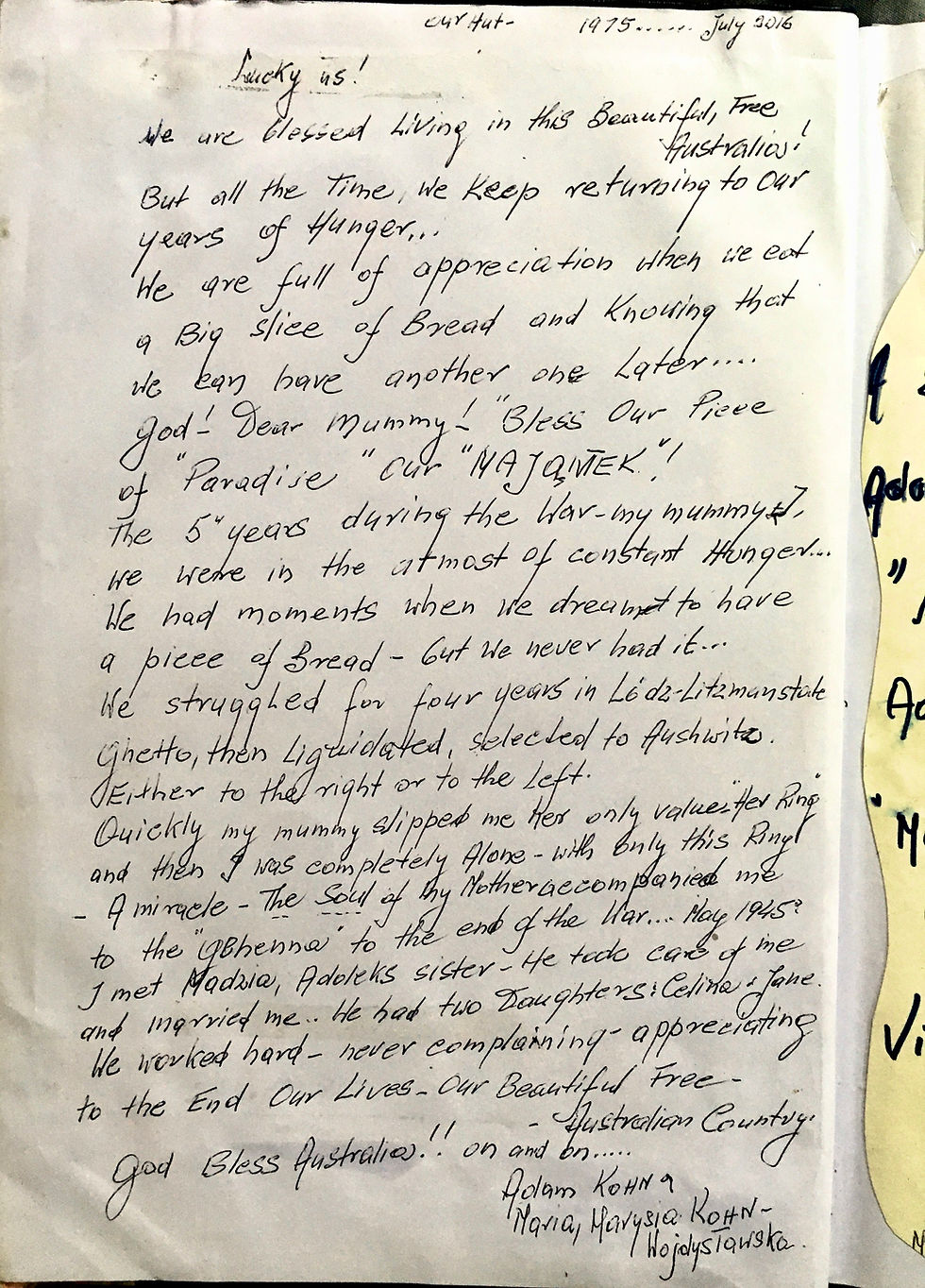
It was a dream she never believed could come true.
But it did.
This modest hut became her dream come true.

There, Mum would sit by the fireplace reading, or wander outside -— in awe of the tall eucalyptus trees, the fresh air and the blue sky.
Nowhere else but there, did she feel she had truly realised her dreams.

It was her Paradise.
But life did not begin in Paradise.
Mum was born in Zgierz, near Lodz in Poland, in 1923 or 1924 — the only child of Cecilia Messing and Yaakov Wodyslawski. Although the family was materially comfortable, her early years were marked by her parents’ unhappy marriage. .
She also faced antisemitism from a young age. Mum often told a story from her childhood:
In her hometown, three young brothers waited in the gutter each afternoon to beat up Jewish children walking home from school. One day, when Mum was about eleven, she’d had enough. She grabbed a wooden bat, marched outside, whacked each boy on the head, then raced home and hid under her bed.

Soon afterwards, the boys’ father, a butcher wearing a blood stained apron, came storming to the door shouting:
‘Where’s your daughter!? She nearly killed my boys!’
From that day on, whenever Mum appeared, the three bullies ran to the other side of the street.
***
Mum was fifteen when war broke out. She and her parents were forced into the Lodz Ghetto. At first she plaited straw for German army boots, and later worked on machines producing metal parts for time-bombs.
Her father, by then living separately, died of hunger. Mum sat shiva alone beside his body through the freezing night.
***
After four bitter years, Mum and her mother were deported to Auschwitz.
On arrival, Mum was sent to the right, while her mother was sent directly to the gas chambers.

Mum survived six harrowing weeks before being transferred to the Halpstaat labour camp [in Czechoslovakia], where she was liberated by the Russian army in 1945.
Soon after liberation she met Dad.
He recognised his sister Madja walking outside the camp —- and with her was her friend — Mum.

The three joined a group of young survivors planning to leave Poland and study in Russia.
When Mum told her surviving aunty of the plan, her aunt insisted on first meeting one of the group. Mum chose to take along Dad because he was always kind to her, and saved food for her whenever she returned late from work.
Her Aunty famously told Dad:
If you marry my niece, I’ll allow her to travel with you.
And so, at 4 o'clock that very afternoon, under four broomsticks and a towel for a chuppah, with a borrowed ring and a so-called Rabbi, Mum and Dad were married.
They reached Russia but were turned back at the border because the guard said no Jews were allowed to enter. Instead, they eventually made their way to Munich, where Dad studied architecture, and Mum worked as a nurse.


Celina was born there in 1947, named after our grandmother, Cecilia.

In 1948, Dad’s cousin managed to purchase permits for them to migrate to Australia. Originally they had planned to emigrate to Palestine with Dad’s sister and brother, but by then Mum wanted to get as far away as possible from Europe and its hatred of Jews — and Australia seemed far enough away to be safe.
They boarded the cargo ship The Eridan, and travelled for nine long weeks as stateless immigrants.


They arrived in Sydney in January 1949, sleeping on tables at the Salvation Army hostel, and using the curtains for blankets. The next morning they caught the train to Melbourne.
Mum later recalled staring out the train window at the wide Australian bush and feeling real freedom for the first time in years.
Of that time she said:
’We were two poor students and a one-and-a-half year old child, with a few pounds and a small suitcase full of nappies.
But at least we were safe’.


Their early years here were tough. Dad’s architectural degree was not recognised, so he had to find work in a textile factory, while Mum finished ladies’ coats at home and cared for little Celina.
They saved every penny, moving house six times in their first year.
In 1955 Dad bought a knitting machine and began producing scarves and ties in a small rented room in Brunswick Street.
The business slowly expanded into Emporium Knitwear in Collingwood.

Mum also began taking the children of their immigrant workers on outings - a play, a movie, an art show— knowing they had few opportunities like these. There’s a photo of her standing happily with three of the workers’ children outside the National Gallery of Victoria.

The business grew steadily until they sold it in 1985. They were always grateful for the opportunities Australia gave them.
***
Mum had one lasting regret - missing out on an education. Her schooling ended in Year 9 when the war began. Finally, thirty years later, in the 1970s, she returned to study at Melbourne University.
She began by studying Early Christian manuscripts, driven by a need to understand the roots of antisemitism. Later she studied in the Islamic Studies department, and in her late eighties completed her final subject, ‘Women and Islam’.
I remember her small study overflowing with library books, with notes pinned across the walls and curtains. We still have her long essays with her lecturer’s comments, bound together in thick manilla folders.

By then Dad was becoming frail and needed more of her care.
Recently I contacted her former lecturer. Even after fifteen years, he was eager to visit Mum and pay his respects.

During the visit he shared a memory: Years earlier, after a lecture on God and religion, 'Maria', as he knew her, handed him a small scrap of paper.
On it she had written:
“Where was God at Auschwitz?”
I was moved, that after all those years, he still treasures that note.
***
After Dad died, Mum — then 93 — moved into my home and lived with us for five wonderful years. She was surrounded by love, and everyone in the household cared for her like a Queen.

In 2022, she moved into aged care after repeated falls and a broken hip. Each time we thought it might be the end, she surprised us again with her resilience and strength.

***
Mum passed away peacefully on Wednesday 20/5/26, marking the end of an era.
As someone recently wrote:
“The world loses yet another witness to the horrors of Auschwitz at a time when Jew-hatred is spreading again.”
A decade or two ago, this hall would have been filled with Mum and Dad’s friends—- those remarkable survivors who crossed oceans and rebuilt their lives from nothing.
Today only a few remain. One of them, Inka Weinstein, is with us today. She travelled to Australia with Mum and Dad on The Eridan in 1949.
The others look down on us.
In recent years, we have seen hatred return in ways that would have felt painfully familiar to Mum.
I often wonder how she would have responded to today’s dark times – to October 7th and the ongoing war, to the silence of friends, the distorted media, and the rise of antisemitism, or antizionism even here, in the Australia she once loved so much.

I can imagine her raising her fist, in true Marysia style and declaring:
“Bugger the haters. We will fight.
Chazak v’amatz — be strong and of good courage.”
And she would have meant it with every cell of her body.
She had always been a tireless fighter for Israel & the Jews.

We honour Mum by carrying her memory forward — by telling these stories, by standing up against hatred, and by living with the same love, courage and curiosity she showed every day of her life.
Mum leaves behind a beautiful family:
her daughters Celina and me, Graham and Ronny;
her grandchildren -- Justine, Anton and Emma, Yaakov, Sunny and Amir, Yasmin and Liad, and Gil & Jimena.
and her great-grandchildren -- Sabe, Sienna, Mia, Evie, Ben, Eitan, Alma and Yonatan.
She survived the worst of humanity and spent the rest of her life showing us the best of it.

With so much love, we farewell our darling Marysia — our beloved mum, nana and friend.
May her memory be a blessing
Bless you Mum.
May you finally Rest in Peace.


Jane:
This is a beautiful distillation of the life of a cherished and adored woman, your mother Marysia. You make it possible for those of us who never met her, to still know her and to learn from her remarkable life.
With love from your cousin,
Sandra Katz
Dear Jane,
You have depicted your Mum's eventful life in a beautiful way. Horrors of Auschwitz separated your Grandmother Cecelia from her daughter. You have mentioned this heartbroken event which has brought tears to our eyes. From that moment the actual journey of struggle began for your Mum. Your Mum was truly a versatile Genius. The decision she took to come to Australia was really justified for upbringing her future generations.She lived her life to the fullest extent.
Personally it is a great loss for me that I could not meet your Mum, a living History.
Pray to The Almighty to give you emotional resilience to navigate through this Heavy situation.
Most sincere respect and gratitude to this Great Lady…
Dear Jenny,
This is a truly remarkable biography of our dearly beloved Marisha. You have preserved her memory with such warmth and love that, while reading these pages, one can almost feel her kindness, radiant smile, and unwavering optimism once again.
May her bright, joyful, and wise spirit live on forever in the hearts of her children, grandchildren, and future generations. May her memory be eternal, and may we bow our heads in gratitude for the beautiful family she created and for the children and grandchildren she raised with love, kindness, and dignity.
Thank you for this priceless gift.